
A straightforward Legionella risk assessment for rented homes in Aberdeen city and suburbs. We visit, check your hot and cold water system, and email you a written report you can hand to a tenant, letting agent or licensing officer. From £55 with no VAT.
Need other services? EPC Certificate | PAT Testing | Combined Packages
A Legionella risk assessment looks for the conditions the bacteria need: water stored or sitting between 20°C and 45°C, somewhere for it to feed, and a way to breathe it in as fine spray
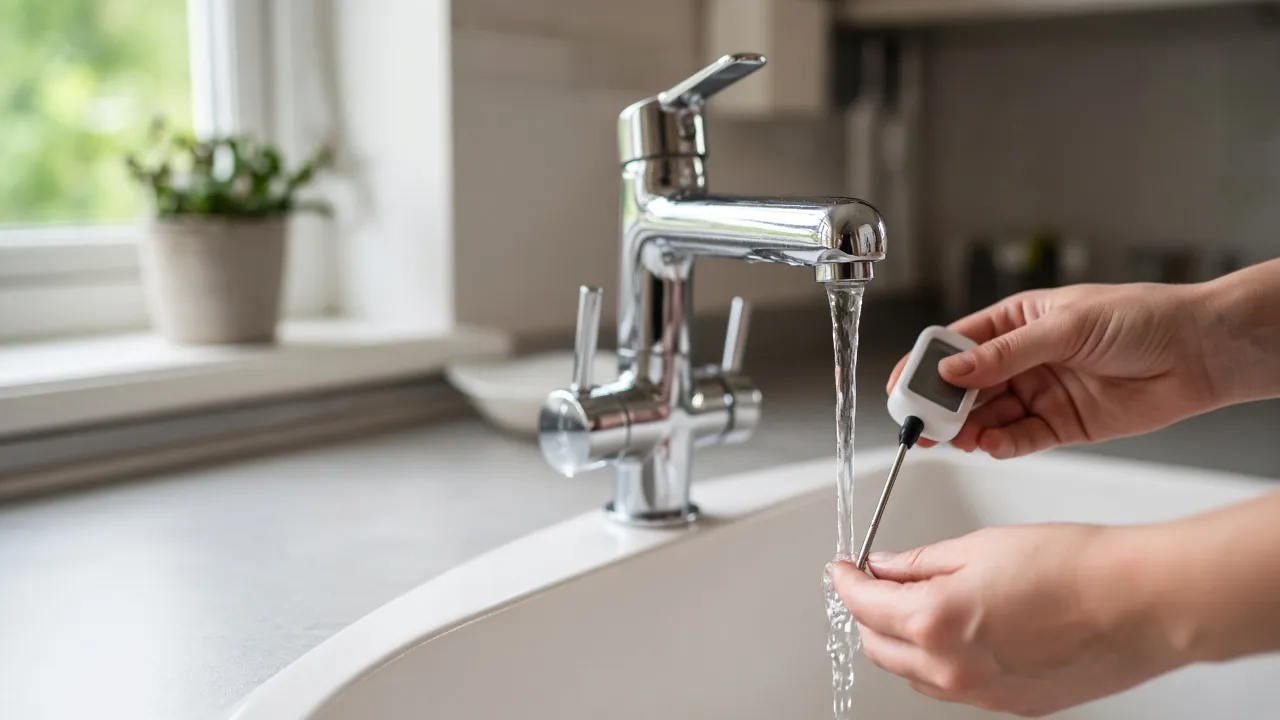
We measure the temperature at the hot water cylinder or boiler and at the taps and showers. Stored hot water should be at 60°C, hot taps should reach 50°C within a minute, and cold water should run below 20°C after two minutes. Readings outside these ranges go in the report.
We look at cold water storage tanks for lids, insulation, debris and scale, check for dead legs and redundant pipework where water sits still, and note outlets that are rarely used, such as spare bathrooms, outside taps and ensuite showers.
Showers, spray taps and hoses are where the bacteria can be breathed in. We check showerheads and hoses for scale and biofilm and record whether they are cleaned and descaled regularly, which the HSE suggests every three months.
Legionnaires' disease is a form of pneumonia caught by breathing in water droplets carrying the bacteria. The risk in an ordinary home is low, but the duty to assess it is yours
Under the Health and Safety at Work Act 1974 and COSHH 2002, anyone in control of premises, including a landlord renting out a single flat, must assess the risk of Legionella and keep it under control. Since 2022, Scottish short-term let licences also ask for a Legionella risk assessment. It does not need to be elaborate, but it does need to exist and be written down.
Combi boilers with no stored water are low risk. The risk rises with a hot water cylinder set too low, a cold tank in the loft without a lid, long pipe runs to a rarely used bathroom, or a property left empty between tenants with water standing in the pipes. A short survey finds these quickly.
Older people, smokers, heavy drinkers and anyone with a weakened immune system or an existing lung, heart or kidney condition are more likely to become seriously ill. If your tenants fall into these groups, the report says so and the recommendations reflect it.
A small local business, not a national call centre
Most of our landlord customers book the Legionella risk assessment alongside an EPC and PAT testing. One appointment, one set of keys to collect, and all the paperwork a letting agent asks for at the start of a tenancy.
We have worked with landlords and letting agents across Aberdeen city and suburbs since 2012, so we know the tenement stock in the city and the older rural properties with tanks and long pipe runs.
The written report is emailed as a PDF within 24 hours of payment.
The price covers the visit and the report. There is no VAT to add and no call-out fee. If a follow-up is needed after remedial work, ask and we will quote before we come out.
About 30 minutes for a typical house or flat. We need access to the boiler or cylinder, every tap and shower, and the loft if there is a tank
We identify how the property is fed: mains only, combi boiler, hot water cylinder or stored cold water. Then we list every outlet and note which ones are in daily use and which are not.
Hot water at the cylinder and at the furthest tap after one minute, cold water at the nearest and furthest taps after two minutes. We also check the cylinder thermostat setting and the condition of any tank.
Each finding is rated low, medium or high. For most homes with a combi boiler and taps in daily use, the overall rating is low and the report simply confirms that. Where it is not, we say what is causing it.
A PDF arrives by email within 24 hours of payment. It records the system, the temperature readings, the risk ratings and a short list of actions, such as raising the cylinder thermostat, fitting a tank lid or flushing a spare shower weekly.
Honestly, yes. The HSE says a landlord who understands their own water system can assess a single house or flat themselves, and does not need to be accredited to do so. In practice most landlords and almost all letting agents prefer an independent assessment with temperature readings and a dated report, because that is what a tenant, a licensing officer or an insurer will ask to see. That is what we provide, at a price that reflects the fact it is a short job.
The Health and Safety at Work Act 1974 and the Control of Substances Hazardous to Health Regulations 2002 (COSHH) require anyone in control of premises to assess and control the risk from Legionella. The HSE's Approved Code of Practice L8 and guidance HSG274 Part 2 set out what a reasonable assessment of a hot and cold water system covers. Our terms explain what our report does and does not certify.
No VAT on anything. The price you see is the price you pay.
Aberdeen city and the suburbs, from our base in Banchory
Union Street, Rosemount, Ferryhill, Old Aberdeen
Tenement flats and HMOs
Dyce, Blackburn, Bucksburn, Kingswells, Bridge of Don
Rented family homes
Westhill, Cults, Peterculter
Family homes on the west side of Aberdeen
Our base
Older properties with tanks and long pipe runs
Aberdeen city and the suburbs, including Bridge of Don, Dyce, Westhill, Cults, Peterculter, Kingswells, Bucksburn, Blackburn and Banchory.
Call or message 07719 975799 with the property address and when a tenant or agent can give access. Most visits are booked within a few days.
Get in Touch